
Air Force Challenge Coin Examples by Unit
Renita WingfieldKey Takeaways
- Specific mission cues give Air Force challenge coins their meaning, and unit emblems work best when they are paired with clear visual proof of the unit’s actual job.
- Aircraft based coins need exact silhouettes because aviation crews will notice shape errors before they notice finish, color, or edge style.
- Training, maintenance, airlift, fighter, and Security Forces units each need a different design center, so borrowed symbols usually weaken the final piece.
The best Air Force challenge coins are easy to place because they show a unit’s job, aircraft, and lineage with almost no guesswork.
That standard matters because the Air Force operates more than 5,000 manned and unmanned aircraft. A coin tied to a fighter squadron will look wrong if it uses a generic eagle, a borrowed tail flash, or an aircraft outline that misses the nose shape. You’re not just looking at decoration. You’re looking at a small metal record of who the unit is and what it does.
Most Air Force coins combine unit emblems with mission cues
Most Air Force coin examples follow one reliable pattern. They place the official unit emblem at the center, then add mission cues that explain what the unit actually does. That is why the strongest unit challenge coins Air Force personnel carry are specific right away and don’t need a long caption to make sense.
A rescue squadron coin might pair its patch with a helicopter outline, pararescue imagery, and a short motto on the reverse. A missile support unit will usually swap aircraft art for launch facility references, crew symbols, or geographic markers tied to its base. Even simple round coins tend to separate identity on one side and mission on the other so the piece stays clear.
You’ll notice that balance on the best designs. Too much symbolism makes a coin feel crowded, and too little makes it feel generic. A good coin gives you enough detail to place the unit fast, while still leaving room for clean relief, readable text, and a shape that feels made for that group.
“A good coin gives you enough detail to place the unit fast, while still leaving room for clean relief, readable text, and a shape that feels made for that group.”
Fighter squadron coins put aircraft identity at the center
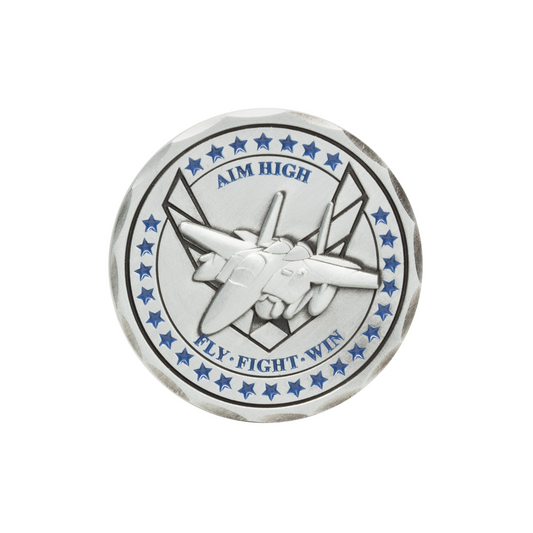
Fighter squadron coins work best when the aircraft profile is the first thing you notice. These coins usually treat the jet as the unit’s visual signature, then support it with the squadron patch, tail code style, or local markings. If the aircraft is vague, the whole coin loses authority.
A strong fighter coin often shows a side profile or climbing angle that matches the actual unit aircraft, then frames it with squadron colors and an aggressive but controlled edge shape. One squadron might use a black nickel finish with a sharp wing outline, while another uses bright enamel and a heritage patch from an earlier era. The difference matters because fighter culture is highly visual and highly specific.
You’ll also see why restraint helps. A fighter coin does not need every weapon station, cloud effect, and flame burst pressed into the die. Aircraft identity, unit insignia, and one or two cues from the squadron’s history will carry the design farther than a crowded front face ever will.
Airlift unit coins show reach through route-based imagery
Airlift unit coins usually center movement, range, and support rather than speed or aggression. Their design language favors routes, globes, cargo doors, runways, and winged motion lines because those symbols explain the mission better than fighter style cues. Air Force aircraft challenge coins for mobility units read best when they show where the unit goes and what it carries.
A transport wing coin might place a heavy aircraft over a curved globe with a route arc that reaches from one continent to another. Another airlift piece could use a lowered ramp, pallet silhouettes, or a loadmaster figure on the reverse to show that the unit’s identity comes from delivery and support. Those details give the coin a different tone from a combat-coded aviation design.
You can usually tell when a mobility coin borrows too much from fighter imagery. Sharp flames, attack angles, and overdone threat symbols pull the design away from the work that airlift crews take pride in. Reach, reliability, and scale are the cues that make these coins feel honest.
Maintenance group coins keep technical pride ahead of decoration

Maintenance group coins land best when they show skilled work before broad patriotic filler. These units support aircraft every day, so their coins usually honor shop identity, technical precision, and sortie support rather than headline imagery. A strong maintenance coin feels earned because it points to labor, standards, and readiness.
A crew chief coin might keep the aircraft small and place launch gear, specialty badges, and the flightline at the center. An avionics section could use circuit patterns, test equipment references, or a maintenance production symbol paired with the unit patch. Those choices tell you more about the unit than another stock eagle or a random flag background ever could.
You’ll get better results when the design leaves room for metal depth and text legibility. Maintenance teams often want names, shop numbers, or shifts included, and those details need clean spacing. The finished piece should feel like a mark of trade pride, not a leftover aviation template with a wrench added at the end.
Security Forces coins rely on shield forms for authority
Security Forces coins usually gain their strength from structure and authority. Shield shapes, badge-inspired edges, and base protection cues tell you that the unit’s mission is security, control, and presence. These Air Force coin examples feel right when the form itself signals protection before you read a single line of text.
A Security Forces squadron coin may use a shield outline with the unit crest on the front and installation gates, patrol imagery, or a motto on the reverse. Another coin might center a defender badge style motif, then add a military working dog, security post, or alert stance figure in low relief. The shape does part of the storytelling before color and text even enter the design.
You’ll notice how quickly the signal breaks if the coin copies a standard aircraft round. The unit can still include air base elements, but the piece should read as protection first. That visual order is what gives the coin its authority and keeps it tied to the people who carry it.
|
Unit focus |
What the coin needs to show first |
|
Coins for fighter squadrons |
The aircraft profile and the squadron insignia should work as one clear identity mark. |
|
Coins for airlift units |
Route imagery and cargo cues should explain movement, reach, and support in plain visual terms. |
|
Coins for maintenance groups |
Technical trade pride should appear before broad patriotic graphics so the unit feels honestly represented. |
|
Coins for Security Forces |
Shield geometry and base protection cues should shape the design before any aviation detail is added. |
|
Coins for training units |
School lineage and class identity should outlast short term platform details that date the piece too quickly. |
Training unit coins highlight lineage more than aircraft detail

Training unit coins usually last longer when lineage leads the design and aircraft detail stays in a supporting role. These units cycle students, instructors, and class years, so the coin has to hold meaning after people move on. Heritage, school identity, and course purpose give the design staying power.
That is especially true because Air Education and Training Command oversees about 1,400 aircraft and more than 60,000 personnel. A pilot training squadron coin may still include a trainer silhouette, but the unit crest, graduation year, and school motto will usually matter more over time. Technical training coins often skip aircraft entirely and lean on specialty symbols tied to the course and location.
You’re seeing a different kind of pride in these pieces. Students want a marker of where they started, and instructors want a coin that still fits after several classes rotate through. Lineage gives both groups a common thread that doesn’t age out with one aircraft assignment.
Aircraft challenge coins work only when the silhouettes stay exact
Aircraft challenge coins succeed only when the silhouette is exact enough for unit members to recognize at a glance. Shape errors stand out fast on aviation coins because crews look at these aircraft every day. A wrong nose line, tail angle, or canopy count will pull attention away from every other good choice.
That is why design proofing matters more than people expect. Shops such as Command Challenge Coins usually ask for side profiles, unit insignia files, and finish notes before a proof moves forward. You should check these details before approving any Air Force aircraft challenge coins:
- The nose profile matches the exact aircraft variant.
- The tail shape reflects the unit’s actual airframe.
- The canopy count fits the crew arrangement.
- The wing form matches the platform in service.
- The markings support the unit and base identity.
You can get away with abstraction on a civic commemorative piece. You can’t do that on an aviation coin handed to pilots, maintainers, or crew members who know the airframe by sight. Accuracy is what turns a cool sketch into a coin people will respect and keep.
“Accuracy is what turns a cool sketch into a coin people will respect and keep.”
Generic symbols make unit challenge coins lose their meaning
Generic symbols drain meaning from unit coins because they flatten distinct missions into the same visual language. A borrowed eagle, lightning bolt, or stock flag set can look polished, but it will not feel personal to the people receiving it. The best Air Force coin examples stay specific enough that the unit can claim them immediately.
A rescue unit, a tanker squadron, a training detachment, and a Security Forces flight should not all end up with the same front face and a different line of text. Good design starts with unit facts such as mission, platform, base, patch, and lineage, then builds a piece that fits those facts. That process takes more discipline, yet the result lasts longer in a pocket, on a desk, or in a display case.
You’ll remember the coins that get the details right because they feel tied to service instead of decoration. Command Challenge Coins fits into that standard when exact insignia, clean relief, and unit-supplied references guide the work from sketch to final strike. That is the difference between a generic keepsake and a coin that still means something years later.