
Types of Air Force Challenge Coins Explained
Renita WingfieldKey Takeaways
-
Air Force challenge coins work best when a single purpose leads the design and presentation.
-
Squadron, commander, deployment, and training coins each carry a different message, so mixing them weakens meaning.
- The strongest coins are easy to read at a glance because the art, text, and occasion all point to the same story.
Air Force challenge coins make sense only when you sort them by purpose.
A squadron coin marks where you belong. A commander’s coin marks who recognized your work. Deployment and training coins mark service periods and earned milestones. The Air Force listed more than 323,000 active-duty Airmen in 2024, which helps explain why units use clear symbols to mark identity and achievement across a very large service.
Air Force challenge coins are grouped by purpose
Most Air Force challenge coins fit 4 main purposes: unit identity, commander recognition, deployment service, and training completion. Some coins also mark retirements, anniversaries, or special events. Those extra cases still work best when one purpose stays dominant. Purpose gives the coin meaning before anyone studies the artwork.
A newcomer coin handed out at squadron in-processing sends a very different message than a coin presented after a demanding inspection or a deployment return. One says you are part of this unit. Another says a leader noticed specific work. A third says you shared a mission during a defined period.
Confusion starts when one design tries to do every job at once. A coin can be beautifully struck and still feel unclear if it mixes command titles, school marks, and deployment dates without a clear reason. People remember why they received a coin long after they forget the edge style. A clear purpose keeps the symbol honest.
“A commander’s coin in the Air Force is a personal recognition coin presented by a commander to mark notable performance, character, or contribution.”
Squadron coins show identity within a specific Air Force unit
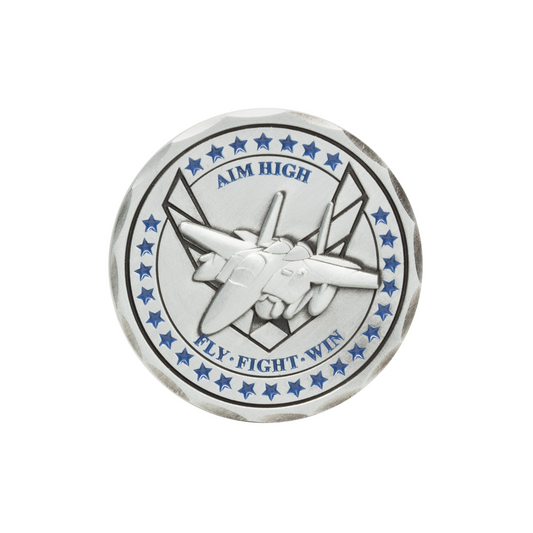
A squadron challenge coin represents a specific unit and the people in it. It usually carries the squadron emblem, motto, aircraft, or shop identity. Air Force squadron coins are about belonging more than rank. They tell you where your daily service is rooted.
A maintenance squadron might issue one coin to every new arrival during an orientation brief and another version for a milestone anniversary. That local identity carries weight because 94% of workers in a 2023 APA survey said it is important to work somewhere they feel they belong. A squadron coin turns that feeling into something you can keep in your hand. It stays with you after PCS moves and leadership turnover.
That staying power is why squadron coins age so well. They aren’t tied to one commander or one short operation. Former members still value them years later because the coin points back to a shared unit identity. If you’re choosing a first coin for a unit, this is usually the safest starting point.
Commander coins mark recognition from a unit leader
A commander’s coin in the Air Force is a personal recognition coin presented by a commander to mark notable performance, character, or contribution. It carries the authority of the office more than the identity of the unit. That is why it feels earned. It records a leader’s judgment in a compact form.
A squadron commander might hand one to an Airman who fixed a sortie-stopping problem before launch or steadied a shop during an inspection week. The moment matters as much as the metal. Presentation is usually direct and specific. The coin becomes proof that important work was seen and named.
That personal meaning requires tight design control. Rank insignia, tenure dates, and presentation timing all have to line up with the commander who is issuing it. Teams such as Command Challenge Coins often ask detailed approval questions for that reason. A commander coin loses force when it looks like a general issue piece.
Deployment challenge coins mark service during a mission period

Deployment challenge coins mark service tied to a specific mission period, location, or operation. They preserve shared hardship, tempo, and separation from home station. A deployment coin is strongest when it tells a bounded story. You should be able to tell when and where the service happened from the coin itself.
A coin from a rotation at Prince Sultan Air Base might place the unit patch on one side and deployment dates on the other. Another from a humanitarian airlift mission could show the aircraft silhouette and theater name. Those details matter because deployment memory is time-stamped. Remove the dates or place name, and the coin starts to feel generic.
Deployment coins carry group memory in a way commander coins do not. Many Airmen can receive the same coin and still attach different memories to it because the shared setting was the mission. That makes these coins strong reunion pieces and lasting keepsakes after separation or retirement. They work best when the design respects the deployment as a clear chapter.
Training coins recognize qualification after formal training
Training coins recognize qualification after a school, course, or formal milestone. They mark readiness and earned capability rather than simple attendance. That is why they should point to a standard that was met. A strong training coin tells you the recipient crossed from learning into demonstrated competence.
A coin issued after technical training, a leadership course, or a specialty milestone works when it reflects the program and the standard behind it. A coin handed out after a short briefing won’t carry the same weight. Recipients know the difference right away. Coins tied to hard gates are the ones people keep on a desk for years.
Training coins can overlap with squadron or commander coins, yet they shouldn’t copy them. Course names, class dates, school marks, or specialty symbols do the job better than broad unit art. You’re marking a skill or credential, so the design should point back to that achievement. That clarity also helps later in a career built across many units.
Design details often reveal the coin's intended use

Design details usually tell you the coin’s intended use before anyone explains it. Unit emblems suggest identity. Rank insignia or command titles suggest personal recognition. Dates and locations signal deployment, while course names and class marks usually signal training. Good design works like a caption that doesn’t need extra help.
Size, finish, and edge style matter too, but they should serve the message. A heavy antique bronze commander coin can feel formal and individual. A bright enamel deployment coin with a map or airframe can feel more commemorative. When artwork packs too many symbols into one face, meaning starts to blur before production even starts.
|
Coin purpose |
What a reader should understand at a glance |
Sign that the design is off course |
|---|---|---|
|
Squadron coin |
It should feel like membership in a unit with symbols members recognize right away. |
If command titles dominate the art, it stops reading like a unit coin. |
|
Commander coin |
It should feel tied to a leader’s recognition of a specific act or standard. |
If it is handed out to everyone, it starts reading like a mass issue piece. |
|
Deployment coin |
It should preserve a defined mission period with dates or location built into the design. |
If time and place are missing, the story fades and the coin feels generic. |
|
Training coin |
It should mark a completed school or qualification with a clear benchmark behind it. |
If everyone who attended receives one, the message of earned progress weakens. |
|
Mixed purpose design |
It should be avoided unless one purpose clearly outranks the others in the final art. |
If the coin needs a long spoken explanation, it is trying to do too much. |
You can use that logic as a quick read before approval. If a stranger can glance at the art and guess the purpose within a few seconds, the design is doing its job. If the purpose needs a spoken explanation every time, the coin is carrying too much. Clear visual hierarchy is part of respect.
“Honor lasts longer when the meaning is settled before the metal is struck.”
Choose the coin type that fits the occasion
Choose the coin type that matches the moment you want people to remember. Start with the reason for presentation, then match design and quantity to that reason. Most mistakes happen when units start with artwork first. Purpose should lead, and production choices should follow.
A short check before approval will keep you from ordering a coin that sends mixed signals. You don’t need a scoring sheet. You need a few hard questions that force clarity on who receives it and why. These 5 checks sort the right path quickly.
- Ask what exact moment the coin is supposed to mark.
- Confirm who will present it and how formal the moment will feel.
- Decide if every recipient gets the same coin or a limited issue.
- Match dates, insignia, and text to the intended purpose only.
- Set quantity and finish after the purpose is fully locked.
A unit welcome coin, a commander recognition coin, and a deployment keepsake can all look impressive, yet they shouldn’t be chosen with the same logic. Presentation method, timing, and audience matter as much as art. If you answer the 5 checks honestly, the right coin type usually becomes obvious. That saves money, but more importantly, it saves meaning.
Weak coin planning can blur meaning for recipients
Weak coin planning blurs the message and weakens the moment of presentation. People will still notice the craft, but they won’t be sure what the coin stands for. That uncertainty follows the coin for years. A recognition piece should leave a precise memory.
You can see the problem when a single coin tries to serve as a unit welcome, a deployment keepsake, and a commander award at once. The recipient gets mixed signals about status, timing, and purpose. Months later, the story behind the coin is harder to retell. That hurts the tradition the coin was meant to preserve.
Good Air Force coins come from disciplined choices about purpose, design, and presentation. That judgment matters more than novelty, special plating, or extra text around the rim. When Command Challenge Coins works on Air Force pieces, the best results start with that same discipline and a clear reason the coin exists. Honor lasts longer when the meaning is settled before the metal is struck.