
How to use AI to generate a challenge coin design
Renita WingfieldKey Takeaways
- AI works best for challenge coin design when you set manufacturing limits before you generate concepts.
- Strong prompts focus on hierarchy, readable text zones, and a small number of symbols with clear roles.
- The handoff to production should happen once the concept is clear and the remaining work is technical refinement.
Generating a challenge coin design with AI takes minutes. Getting that concept into production without costly revisions takes considerably more preparation. As generative AI tools become standard in creative workflows, more people are using them to sketch out coin concepts before approaching a manufacturer. According to McKinsey's 2024 State of AI report, 65% of organizations now regularly use generative AI across their operations. Coin design is no exception to that shift.
The gap between a polished AI image and a file ready for die-struck production is wider than most people expect. AI tools generate visual ideas, and the manufacturing specification is a separate document that comes after. Understanding where AI adds genuine value and where it falls short is what separates a concept that inspires a finished coin from one that stalls in revision cycles before production can begin.
What AI tools can actually do in coin design
AI image generation tools produce visual references rather than production-ready files. Their value in coin design lies in concept exploration: you can test shapes, motifs, text layouts, and symbolic elements quickly without committing to a final direction. Tools like Midjourney, Adobe Firefly, and DALL-E accept text-based prompts and return coin-style imagery that communicates your intent clearly enough to anchor a design conversation.
A military unit might use an AI generator to produce six layout variations, each featuring a different arrangement of an eagle motif, unit designation, and motto, before selecting the strongest composition to bring forward. That compresses hours of ideation into minutes. What AI won't do is output a vector file, apply die-strike tolerances, or account for how raised metal and recessed enamel interact in a finished piece. You're working with an image, and the technical specification is developed separately by a designer or production team. Recognizing that distinction from the start keeps your project on track and prevents wasted revision cycles once production begins.
How to pick the right AI tool for your coin concept

The right AI tool depends on how much compositional control you need at your current stage in the design process. General-purpose image generators, such as Midjourney or DALL-E, produce visually detailed concepts quickly and work well when you're still deciding on symbolism, layout, and overall style. Vector-capable tools or AI-assisted design platforms give you output that's closer to what manufacturers can work with directly.
A corporate organization designing a recognition coin for a leadership milestone would get faster directional results from a general image generator, but would need to move into a vector editing tool before the file became usable for production. Some platforms offer a middle path with guided templates and basic vector export, which works well for simpler designs with fewer custom elements. The tool you start with shapes how much additional work your design requires before it's ready for professional review. Matching the tool to your current stage in the process matters more than selecting the most powerful option available.
"Including terms like 'hard enamel,' 'die-struck,' and 'high relief' consistently in your prompts generates AI output that closely mirrors a real production specification."
The design elements that translate best to physical challenge coins
Bold silhouettes, hard-edged typography, and flat color regions translate most reliably from an AI concept to a finished coin. Physical challenge coins are produced through die-striking or die-casting, processes that work best with defined edges, separated fills, and strong contrast between foreground and background elements. Fine detail, photorealistic shading, and gradient fills are features that manufacturing equipment fundamentally cannot reproduce in metal.
A coin concept generated with an AI tool might display a detailed portrait with soft shadows and layered tones that look impressive on screen. Once that image reaches a tooling department, those gradients must be converted into flat enamel regions or textured metal surfaces, which typically means significant simplification of the original concept. Knowing this upfront means you can prompt AI tools with constraints that reflect production reality: clean outlines, limited color palettes, and bold primary imagery. A direct look at how individual elements perform under production conditions shows where AI concepts most often need refinement.
| Design Element | Performance in Production |
| Bold raised silhouettes | Reproduces cleanly in die-struck metal with strong visual definition |
| Hard-edged text and numerals | Holds legibility at standard coin diameters of 1.5 to 2 inches |
| Flat, separated color fills | Pairs well with both hard enamel and soft enamel fill processes |
| Fine linework under 0.5 millimeters | Often lost or merged during tooling and metal pressing |
| Photorealistic gradients | Must be simplified to flat tones before they can be reproduced in metal |
| Textured or patterned backgrounds | Competes with foreground elements and reduces overall contrast in the finished metal piece |
How to write prompts that produce production-suitable coin concepts
Effective prompts for coin design specify manufacturing-relevant constraints alongside the visual concept. Rather than describing what the coin represents, describe what it looks like as a physical object: its finish, relief style, color count, shape, and primary imagery. Prompts built this way steer AI toward output that reflects production realities rather than decorative illustration.
Consider two distinct approaches: "military challenge coin for a special operations unit" versus "die-struck antique silver challenge coin, 2-inch round, airborne insignia in high relief, 3-color hard enamel, bold serif unit designation, dark recessed background." The second produces a concept with defined edges, limited color regions, and a composition that maps directly onto standard manufacturing options. Including terms like "hard enamel," "die-struck," and "high relief" consistently in your prompts generates AI output that closely mirrors a real production specification. You'll still need to refine the result, but you'll spend considerably less time doing so because the concept starts from a grounded, technically informed place.
What does a professional-quality AI coin concept look like
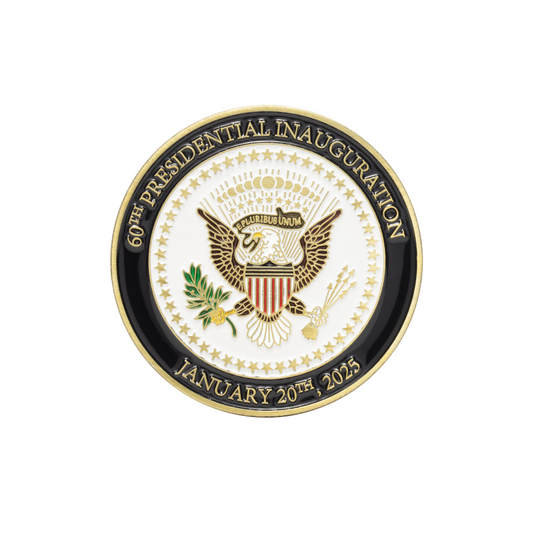
A production-suitable AI coin concept has a clearly defined foreground subject, 4 or fewer distinct color regions, readable text at scale, and a composition centered on a standard coin format. The design reads clearly when reduced to roughly 1.75 inches, close to actual coin size, without losing its primary imagery or becoming visually cluttered.
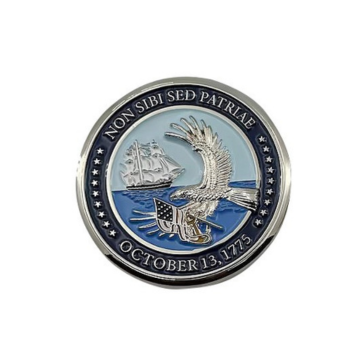
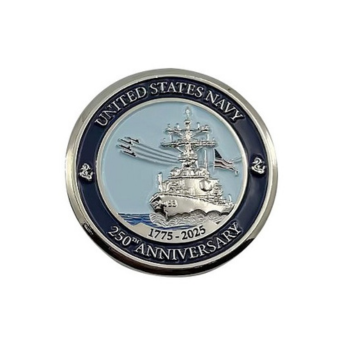
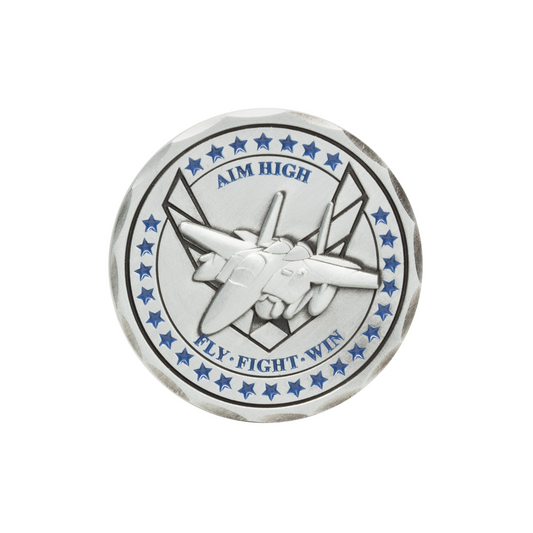
Fire department recognition coins offer a clear illustration of what a production-ready AI concept looks like in practice. An AI-generated version that works well places a department shield in high relief at the center, features the department name and founding year in bold text along the rim, and uses 3 flat enamel colors: a primary red, a secondary gold, and a dark background fill. There are no gradients, no micro-detail, and no overlapping elements competing for visual space. That clarity is what makes a concept manufacturable without extensive redesign. A weaker concept features layered typography, a photorealistic background, and 7 distinct colors, all of which require a designer to rework the image from scratch before production can begin. The difference between these two outcomes comes down almost entirely to how the original prompt was structured.
Why AI-generated artwork still needs refinement before production

AI-generated coin images consistently require professional refinement before they're suitable as manufacturing files. Even the best-prompted AI output produces rasterized imagery with resolution limitations, merged elements, and typographic inconsistencies that don't survive conversion to the vector formats manufacturers use for tooling. Refinement is the step where a concept becomes a workable specification.
Grand View Research valued the global generative AI market at $43.87 billion in 2023, with creative design applications among the fastest-growing segments. That growth has outpaced the development of production-ready output standards, meaning the gap between what AI generates and what a manufacturer can tool directly remains significant. Teams at Command Challenge Coins review AI-generated concepts against physical production requirements before any tooling work begins, a process that consistently catches errors in color count, detail density, and text legibility that would otherwise surface as costly corrections after approval. Skipping this review step is one of the most common reasons custom coin projects stall after initial concept sign-off.
How to hand off your AI concept to a coin manufacturer
Handing off an AI coin concept to a manufacturer starts with converting your image into a format the production team can actually use. Most coin producers require vector artwork in AI or EPS format, with all text outlined and colors separated into named Pantone or enamel swatches. Providing your AI concept alongside a written design brief gives the production team a clear reference point and reduces back-and-forth during proofing.
"The best AI-assisted coin designs succeed because the person who prepared the handoff understood the difference between a concept and a specification."
A complete handoff package typically includes these five elements:
- A high-resolution concept image at minimum 300 DPI showing front and back designs
- A vector redraw of the primary artwork with paths and fills separated by color region
- A written brief specifying coin diameter, finish type, edge style, and metal color
- A named Pantone or hard enamel color reference for each fill area in the design
- A clear notation of any symbolic elements, mottos, or unit identifiers that must be preserved exactly
Command Challenge Coins has produced coins for military units, government agencies, and first responder organizations where the design process began with an AI-generated concept. Getting the handoff package right the first time gives skilled craftspeople enough clarity to honor the design intent and produce a coin that carries real meaning. The best AI-assisted coin designs succeed because the person who prepared the handoff understood the difference between a concept and a specification.